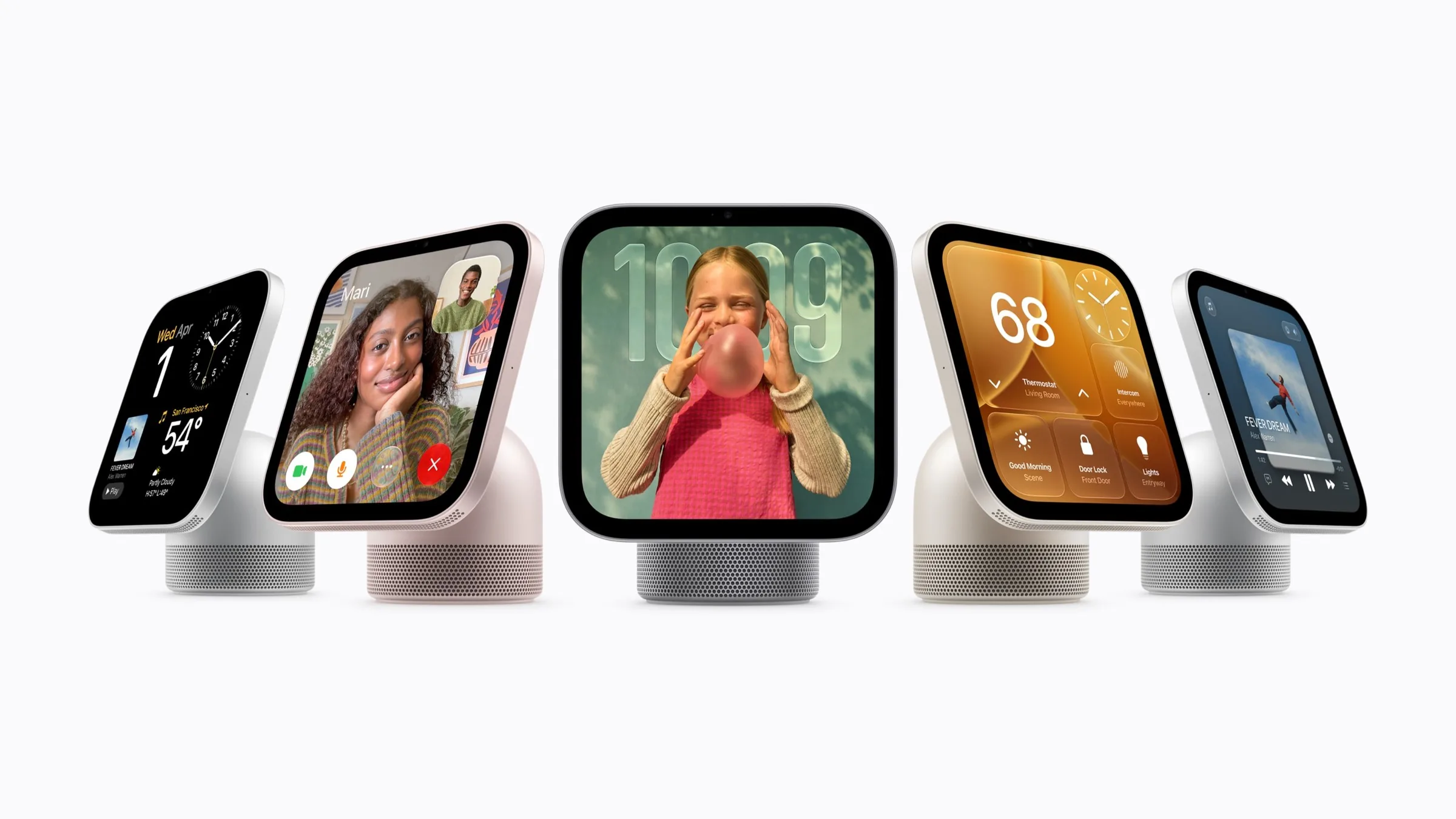
Apple finally has a smart display. Apple HomeView is a 7-inch screen on a domed speaker base that knows whose face is in front of it: it recognizes up to six people and switches to each one’s own Home Screen, Apple’s announcement says. Siri AI, Apple’s all-new version of Siri, now sits at the center of it.
Six faces, six Home Screens
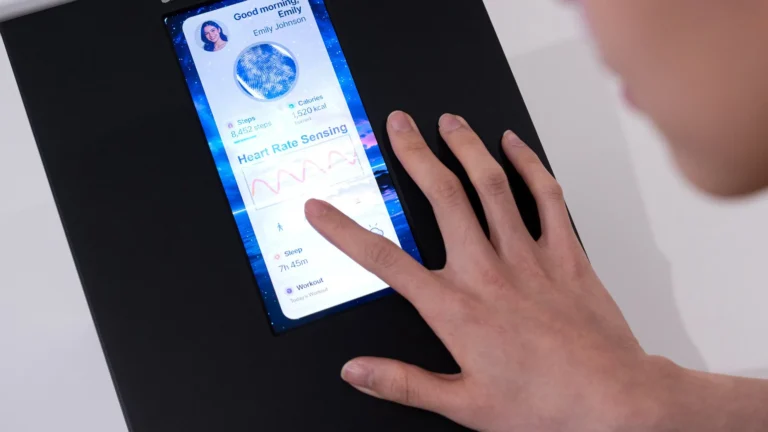
Walk up and HomeView shifts from the household screen to yours (if it knows who you are), with your own apps and widgets. Shared albums and music stay open to everyone, guests included.
Personal content needs two keys, though: HomeView has to recognize your face, and your paired iPhone or iPad has to be present and recently unlocked. So your face alone won’t open your messages.
Recognition runs in Secure Exclaves on the A18 chip, which Apple calls “protected and compartmentalized runtimes”: they process camera and microphone data apart from the rest of the system. Apple says nothing processed there can be reached by HomeView’s software, its apps, the user or Apple.
All new Siri AI
Siri AI is an entirely new version of Siri, built on the next generation of Apple Intelligence. It is built so that anyone can ask it about virtually any topic and keep a conversation going, Apple Intelligence iPhone or not.
Pair an Apple Intelligence iPhone or iPad and it gets personal. It can pull up a party invitation from your calendar, find the RSVPs in your messages and take action across your apps. A conversation started on HomeView carries over to the Siri app on your other Apple devices.
Requests run on the device or on Private Cloud Compute, Apple’s cloud system, which Apple says doesn’t store your data. Siri AI on HomeView is a beta in English in the US, Australia, Canada, India, New Zealand, Singapore, South Africa and the UK.
So what’s the catch? Some server-side Apple Intelligence features come with daily usage limits, and Apple says “expanded access to such features will be available for a fee in the future.” The AI is free – until it isn’t.
The screen, the sound and the wall model
A stainless steel hinge tilts the screen toward you. Brightness runs from 500 nits for a sunlit room down to 0.3 nits for the nightstand, which Apple calls its lowest ever. The interface shows big, simple information from across the room and more detail as you step closer.
Apple’s spec sheet adds that the panel is square, at 1088 by 1088 pixels.

The dome is where the bass lives: a down-firing woofer and two passive radiators (unpowered cones that add bass). Two full-range drivers in the display deliver crisp Spatial Audio, and computational audio tunes loudness and bass in real time.
FaceTime here uses a 12MP Center Stage camera that keeps everyone in frame as they move. Recipes from Safari turn into step-by-step instructions with hands-free timers, and shared albums turn the Photos face into a picture frame.
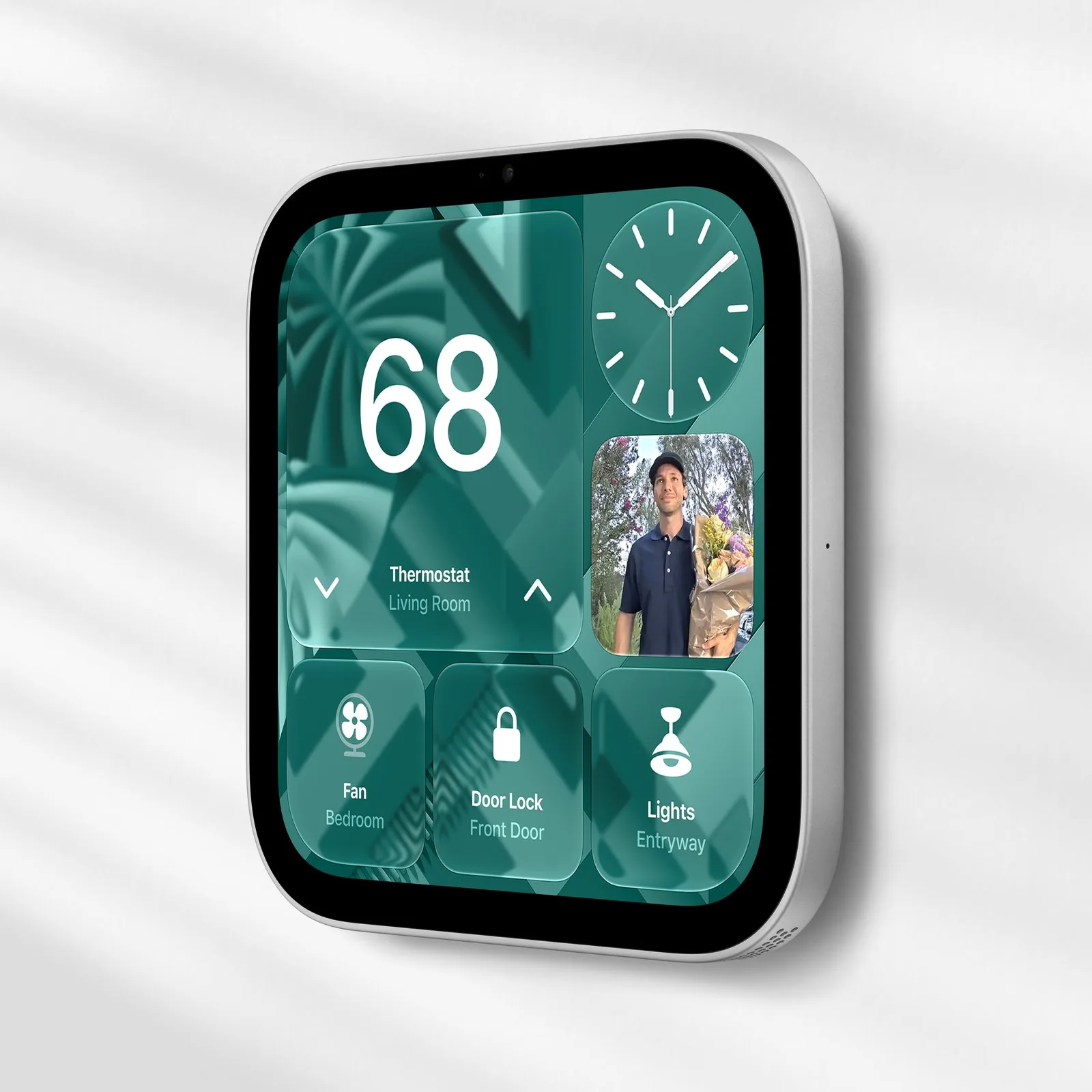
HomeView controls lights, locks, thermostats and blinds by touch or voice, and its Home Camera face streams up to nine camera feeds at once. It works with Apple Home Collection, Apple’s new cameras, lock and thermostats, plus other Works with Apple Home and Matter (the cross-brand smart home standard) accessories.
The wall-mounted model keeps the screen in a body 0.39 inch thick, but gets only two drivers and no woofer. It just needs one of three Schneider Home mounts, sold separately.
Apple HomeView key specs
- Display: 7-inch Liquid Retina (LED-backlit IPS), 1088 x 1088 pixels at 220 ppi, True Tone, 500 nits maximum, 0.3 nits minimum
- Processor: A18 with Secure Exclaves
- Camera: 12MP Center Stage, f/2.4
- Speakers: tabletop: two full-range drivers, a down-firing woofer and two force-cancelling passive radiators; wall-mounted: two full-range drivers; Spatial Audio with Dolby Atmos
- Microphones: four, for far-field Siri
- Connectivity: Wi-Fi 6E, Bluetooth 6.0, Thread
- Sensors: ambient light, temperature and humidity, accelerometer
- Power: USB-C; tabletop ships with a 1.5m cable and a 30W adapter; wall-mounted needs a mount, cable and adapter (20W minimum), sold separately
- Software: Siri AI in beta in HomeView software 27.2; setup needs an iPhone with iOS 27.2 or an iPad with iPadOS 27.2 or later
- Size and weight: tabletop 5.73 x 5.38–6.82 x 3.78–5.13 inches (14.55 x 13.67–17.32 x 9.60–13.02 cm), 952g; wall-mounted 5.73 x 5.73 x 0.39 inches (14.55 x 14.55 x 0.98 cm), 286g
- Colors: tabletop in silver, starlight, rose pink and space gray; wall-mounted in silver and space gray
- Other: face recognition for up to six users
Both models of the HomeView cost $299 (about Php 18,800) in the US, which is how much Apple charged in January 2023 for the 2nd-gen HomePod speaker. In Singapore, you’ll pay S$399 (about $310 or Php 19,600) while in India, it costs ₹39,900 (about $415 or Php 26,100).
Pre-orders are now open in Australia, Canada, India, New Zealand, the UK and the US, and will open in Singapore on Thursday, October 15th, at 9:00 am Singapore time (9 a.m. Manila; 6 p.m. PT, October 14th). Both models arrive on Friday, November 13th, also in South Africa through Apple Authorized Resellers.
The wall mounts start at $59.95 (about Php 3,800) for the Power Mount USB-C Wall Connector and $79.95 (about Php 5,000) for the Power Mount AC Wired, both on order now. The Power Mount PoE Wired, which runs on a network cable, follows in early 2027 at $129.95 (about Php 8,200). So the cheapest wall setup is $358.95 (about Php 22,500), before any cable or power adapter it needs.
HomeView isn’t sold in the European Union (EU) for now. Apple says Siri AI is currently unavailable in iOS in the EU, and that it’s working with the EU to find a path forward.
Correction, October 14th: The wall-mounted HomeView is a separate model, not the tabletop one hung on a wall.