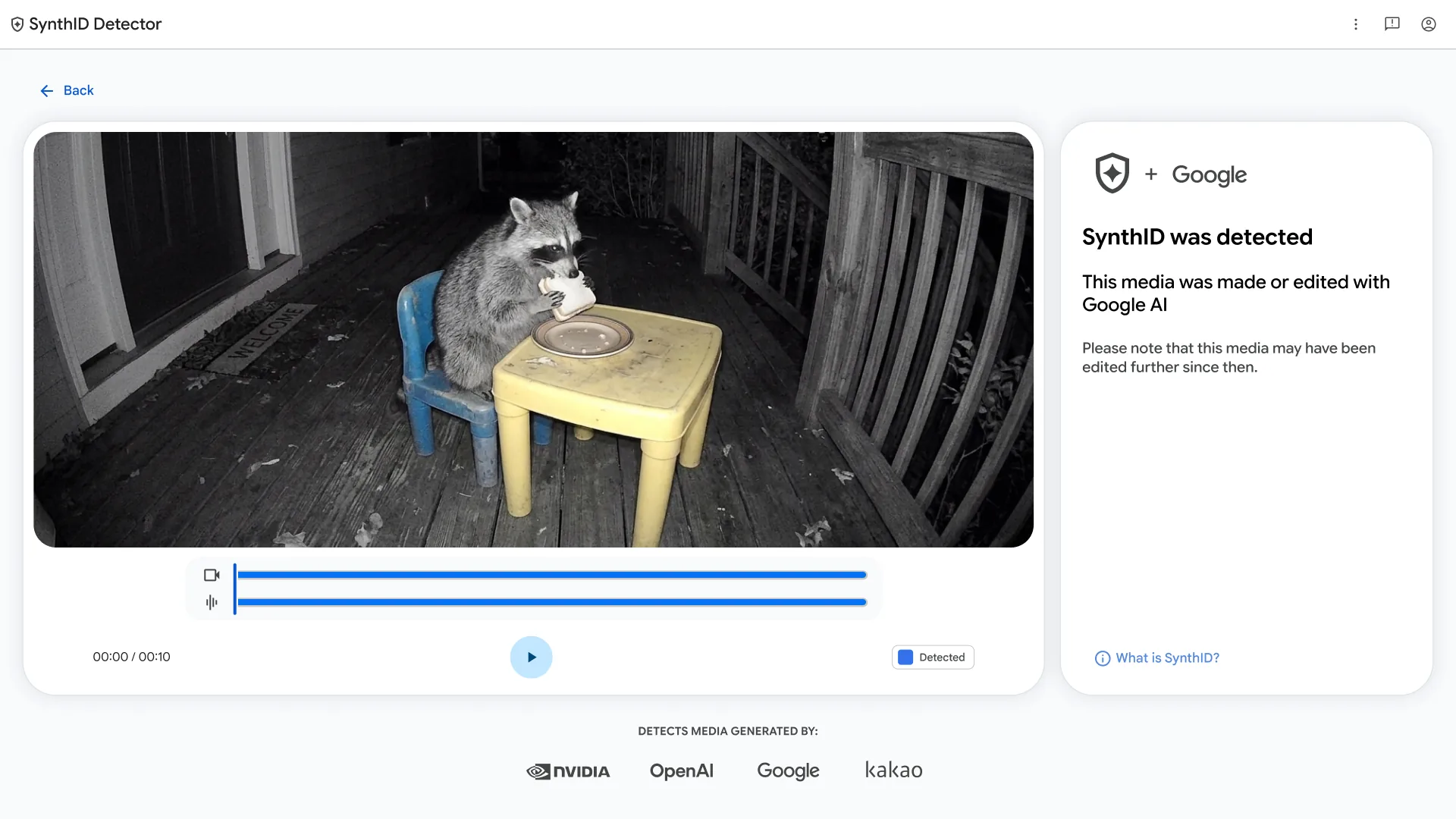
Anyone can now check a file for Google’s AI watermark. Google opened its SynthID Detector to everyone on October 7th, in English and worldwide. You can upload an image, video, or audio file, and find out whether it carries SynthID, the invisible watermark Google stamps on its own AI-generated content. OpenAI, Nvidia and Kakao use the same watermark as well, and Google said Apple is coming “soon.”
It’s available online at synthid.com. Until now, only media professionals could use it, starting with an early version in 2025. Files can be up to 100MB, and Google said uploads are deleted as soon as you get your result. There’s a cap, too: Google’s terms mention daily quotas without a number, but online reports say the limit is approximately 10 checks per user. The terms also ban using it to find edits that “break, bypass, or degrade” the watermark. Unlimited checks would make it a free test lab for watermark removers.
The way SynthID works is by hiding the mark inside the content itself: in the pixels of images and video, and in the sound of audio. Unlike a metadata label, which a screenshot can’t carry, this is built to survive filters, color changes, and compression. Google said it has watermarked over 180 billion images and videos since 2023, plus 240,000 years of audio. (Yes, years.) Its checks in Search, Gemini and Chrome already handle over 1 million requests a day.
Google’s own FAQ is refreshingly honest about the limits of this new tool. A “detected” result means the file was likely made or edited by a SynthID-enabled model. A miss only means no confident signal turned up, which Google said “does not totally rule out AI generation or manipulation.” The file may come from a model that doesn’t use SynthID, or heavy edits may have worn the mark away. In very rare cases, it can also “falsely trigger” on a file that was never watermarked. For now, the site doesn’t check text, so ChatGPT’s new EU text watermark isn’t something you can test here.
The take
We’re glad Google opened this up because it’s getting harder and harder to know what’s real and what’s AI these days. That said, people making fakes to fool others might not be using tools that sign their work. Either way, you can now check any viral video clip that you suspect might be AI and tell your mother about it, with evidence – in case you ever need to.