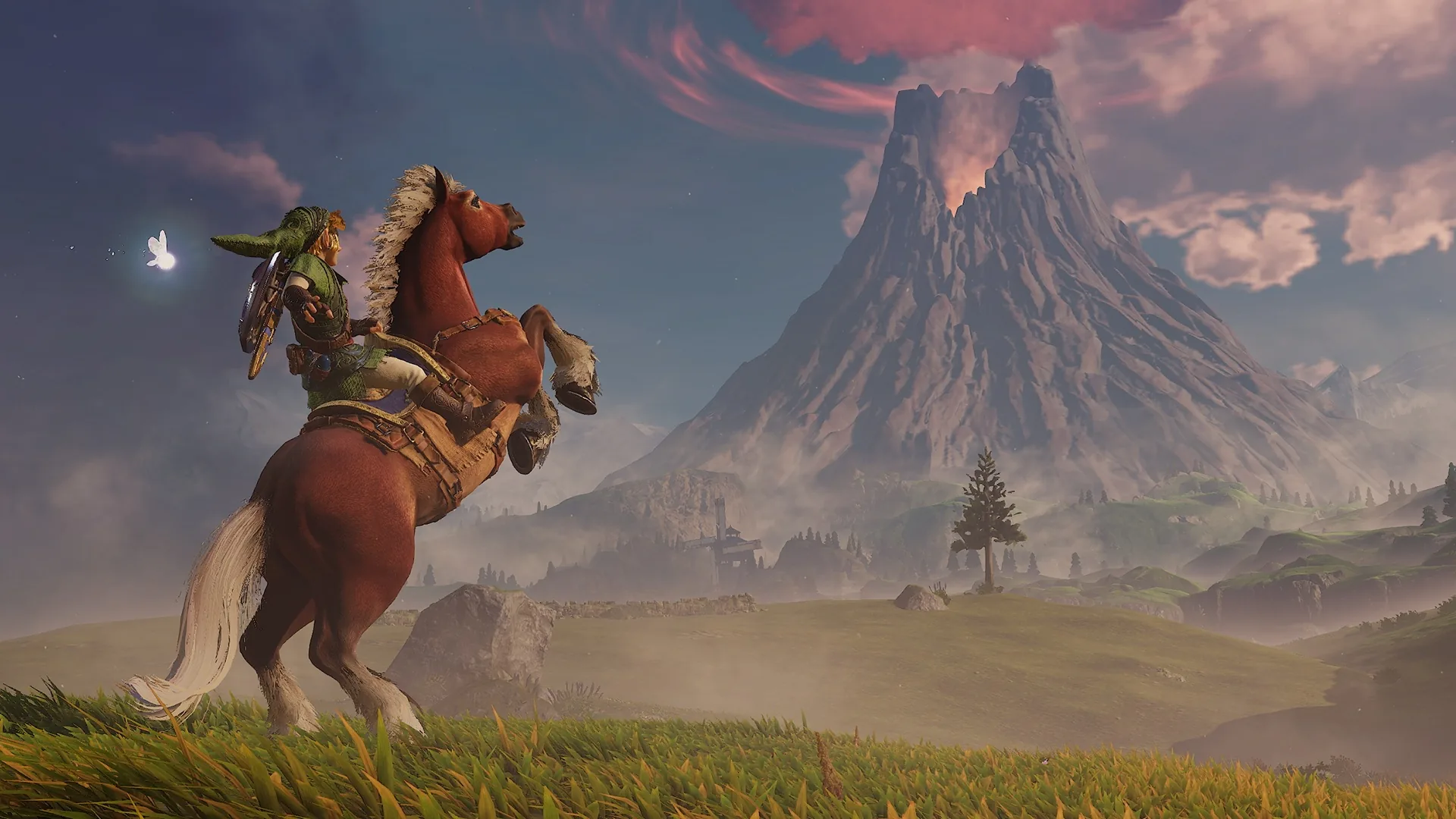
Nintendo’s full remake of The Legend of Zelda: Ocarina of Time for Switch 2 rebuilds Hyrule but keeps the 1998 game’s separate maps instead of one seamless world. The team’s rule was “the visuals may change, but the experience does not,” director HokWai Ng says in Nintendo’s Ask the Developer interview, translated from Japanese.
Ng says the original’s self-contained structure is part of its appeal, unlike the open worlds of Breath of the Wild and Tears of the Kingdom. Moving from one map to the next is meant as a breather, a moment to take stock before the next area. The team even had the artist behind the Nintendo 64 version’s illustrations draw a new map.
Big areas like Hyrule Field were especially hard to balance, art director Aya Shida says. Places you can explore get the most detail, scenery you can’t reach gets less, and landmarks like the castle and the windmill were made bigger, so the screen alone tells you what to explore and what’s just scenery.
Shida’s team aimed for “a puppet-show feel” rather than plain realism: a dark, dense Hyrule where colorful, quirky characters still fit. For Young Link’s clothes, the artists studied fabrics in museums and even tried making their own from thread.
Producer Eiji Aonuma asked for warp points the 1998 game never had, for players who spent the original rolling across Hyrule Field. After the team played with them, he had them all taken out: they skipped the moments where you stop and wonder what something is.
Nintendo lists other changes on its store page: voiced dialogue, expanded cutscenes, symphonic orchestral music, and reworked camera and movement controls that let Link jump and dash. You can also play the ocarina by humming, or playing your own instrument, into the Switch 2’s microphone.
It’s out Thursday, November 5th, only on Switch 2, at $59.99 (about Php 3,800) digital or $69.99 (about Php 4,500) physical in the US.
Aonuma says part of the point, in the series’ 40th anniversary year, was letting a team that mostly knows the newer games learn how the original was built, and carry that into future Zelda games.